
Side Dishes
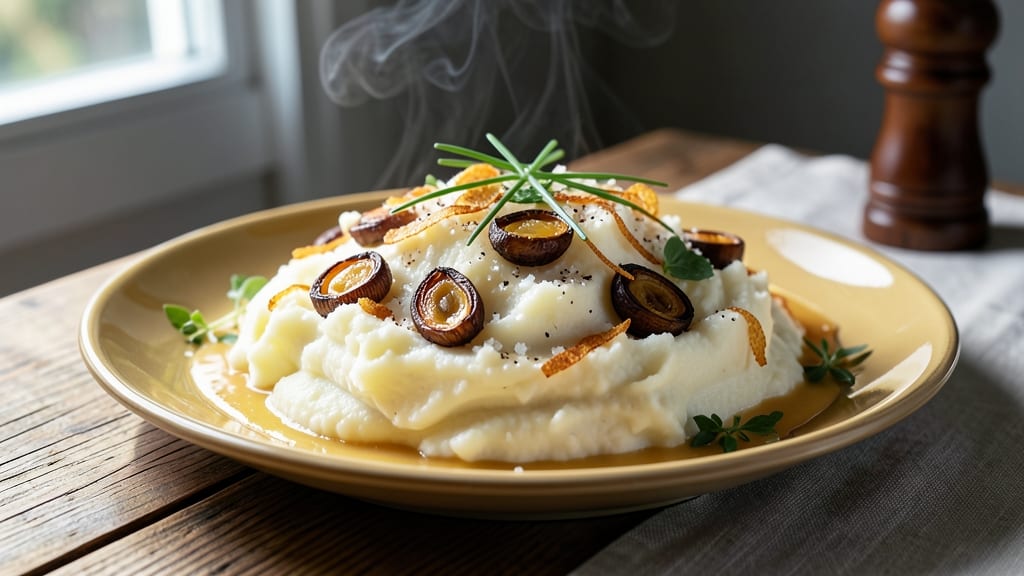
This 20 lb mashed potato recipe transforms holiday feasts with velvety, restaurant-quality potatoes that disappear faster than you can say "seconds, please." The secret lies in precise scaling—peeling, boiling, and mashing in batches to maintain perfect texture while keeping the process manageable.
I've perfected this method after years of holiday hosting, ensuring every guest leaves satisfied (and maybe a little sleepy from all that butter).
What sets this recipe apart is the balance of technique and simplicity. We'll use a combination of whole milk and heavy cream for that signature creamy yet light texture, while roasted garlic and a touch of salt elevate the flavor beyond basic sides.
The key to large batches is controlling moisture—adding ingredients gradually and mashing just until smooth, never overworking the potatoes. This method guarantees fluffy, lump-free perfection that holds up beautifully when reheated.
For holiday gatherings, this recipe becomes your secret weapon—prep ahead in the oven or steam bath, then reheat with precision to maintain that ideal consistency. The aroma alone will have guests gathering in the kitchen, and the first bite will silence any doubts about homemade versus store-bought.
Every detail, from the potato selection to the reheating process, is designed to deliver crowd-pleasing smoothness that becomes the star of your meal.
Whether you're feeding a family reunion or hosting a holiday open house, this scaled approach ensures you'll have enough for everyone—with leftovers that reheat beautifully for days. The method is foolproof, the results are impressive, and the process is designed to minimize stress during your busiest cooking days.
Let's get started on creating the creamiest mashed potatoes your guests will ever taste.
Ingredients for 20 lb mashed potato
Twenty pounds of potatoes, creamy perfection, and holiday magic—just add guests.
| Ingredient | Amount | Notes |
|---|---|---|
| Russet Potatoes 🥔 | 20 lb | Medium size, peeled and quartered |
| Unsalted Butter 🧈 | 3 cups | Cold, cut into 1-inch cubes |
| Whole Milk 🥛 | 2 cups | Room temperature |
| Heavy Cream 🥛 | 1 cup | Full-fat for richness |
| Roasted Garlic Cloves 🧄 | 12 whole | Roasted until caramelized |
| Kosher Salt 🧂 | 2 tbsp | Diamond Crystal preferred |
| Freshly Ground Black Pepper 🌶️ | 1 tbsp | Freshly cracked for best flavor |
| Fresh Chives 🌿 | ½ cup | Chopped, for garnish |
| Granulated Sugar 🍚 | ¼ cup | Balances acidity |
| Vegetable Oil 🫒 | ½ cup | For roasting garlic |
| Aluminum Foil 📄 | 1 sheet | Heavy-duty, for covering |
| Large Stockpot 🍲 | 1 piece | 8-10 quart capacity |
| Hand Mixer 🔄 | 1 piece | For smooth texture |
| Instant-Read Thermometer 🌡️ | 1 piece | For accurate doneness |
The potatoes are non-negotiable. Russets are your best bet—they're starchy and fluffy, not waxy. Buy them a week ahead and store in a cool, dark place (not the fridge). Costco or local farm stands usually have the best prices for bulk. For roasting the garlic, wrap whole cloves in foil with a drizzle of oil and roast at 400°F for 35 minutes. That caramelized sweetness is what transforms basic mashed potatoes into a showstopper. The butter? Store-brand works fine, but if you want to splurge, go for European-style—it melts differently and adds depth. I always buy it in bulk from Walmart's Great Value line—cheaper and lasts forever.
No heavy cream? Full-fat coconut milk works in a pinch, though it's slightly sweeter. Short on milk? Evaporated milk at half the amount adds creaminess without thinning. The sugar might seem odd, but it balances the acidity from the roasted garlic—trust me on this. For the salt, Diamond Crystal dissolves better than table salt, but if that's all you've got, use twice the amount. Fresh chives are ideal, but dried chives at one-third the amount will work if you're in a bind. And if you're prepping ahead? Roast the potatoes in advance—they'll keep in the fridge for up to 2 days before mashing, saving you last-minute stress.
Leftovers reheat beautifully—just add a splash of warm milk and a pat of butter. Keeps for 5 days in the fridge or 6 months frozen. For freezing, portion into gallon-sized bags and flatten to save space. When reheating from frozen, microwave in 30-second bursts, stirring between each, then finish with a hand mixer for that silky texture. The foil-covered stockpot is your friend—it keeps everything warm while you finish other dishes. And if you're really ambitious, make it in a slow cooker on low for 6-8 hours—just add the milk and butter at the end.
Why You'll Love This Recipe
- Set-and-Forget Magic: I swear by this recipe on Thanksgiving—boil the potatoes while I prep everything else, then mash them with the roasted garlic and butter while the turkey rests. No hovering, no stress, just perfect timing.
- Roasted Garlic Kiss: That slow-roasted garlic? It’s the secret weapon—sweet, mellow, and rich, blending into the creamy mash like a warm hug. The heavy cream and milk make it velvety, but the garlic keeps it from tasting flat.
- Party-Ready in Batches: Make the whole 20 lbs at once and freeze portions—perfect for game days, holiday leftovers, or lazy Sundays. My freezer’s always stocked because reheating these is chef’s kiss (just add a splash of milk).
- Budget-Friendly Feast: Russets are cheap, butter and cream stretch far, and this recipe feeds a crowd without breaking the bank. Honestly, I’ve served this at potlucks for under $10 and still had leftovers for days.
Step-by-step instructions for holiday-worthy mashed potatoes
Here's how to transform 20 pounds of russets into velvety, restaurant-quality mashed potatoes.
Roast the Potatoes for Maximum Flavor
Preheat your oven to 425°F. Toss the 20 lb peeled and quartered russet potatoes with 0.5 cup vegetable oil, 2 tbsp kosher salt, and 1 tbsp freshly ground black pepper until evenly coated. Spread them in a single layer on two large baking sheets (don't overcrowd). Roast for 45-50 minutes, flipping halfway, until the edges are crispy and an instant-read thermometer inserted into the thickest piece reads 205°F.
The high heat breaks down the starches more thoroughly than boiling, creating a creamier texture. Roasting also develops deeper flavor—you'll notice a nutty sweetness that's impossible with boiled potatoes. Don't skip this step; it's what makes these potatoes truly special for holiday gatherings.
Cook the Roasted Garlic and Prepare Dairy
While the potatoes roast, place the 12 whole roasted garlic cloves in a small skillet with 0.25 cup granulated sugar and 1 tbsp water. Cook over medium-low heat for 5-7 minutes until caramelized and jammy. Meanwhile, warm the 2 cups whole milk and 1 cup heavy cream in the large stockpot over medium heat until just steaming (don't boil).
The sugar helps caramelize the garlic naturally, adding sweet depth to the potatoes. Keep the dairy warm but not hot—this prevents curdling when we combine everything. I like to use the stockpot because it has enough capacity to handle all the dairy and potatoes together later without overflowing.
Mash the Potatoes to Perfection
Transfer the roasted potatoes to the stockpot with the warm dairy. Using the hand mixer, blend on low speed for 2 minutes to break up the potatoes. Then increase to medium speed and mix for 3-4 minutes until completely smooth. Add the 3 cups cold unsalted butter (cut into cubes) and mix on low speed for 1 minute to incorporate.
Here's the secret: cold butter creates pockets of air that make the potatoes light and fluffy. Don't rush this step—you want the butter to melt gradually while maintaining that silky texture. If the mixture looks too thick, add 1-2 tablespoons of warm milk at a time until it reaches a smooth, spreadable consistency.
Enhance with Roasted Garlic and Season
Remove the hand mixer and use a wooden spoon to fold in the caramelized garlic and its juices. Then stir in the 0.5 cup chopped fresh chives and adjust seasoning if needed. For serving, transfer to a warmed serving dish and cover tightly with aluminum foil to keep warm.
The roasted garlic adds a complex sweetness that balances the richness of the butter and dairy. I like to serve these potatoes immediately, but they'll keep well in the stockpot (covered) for up to 2 hours if you need to hold them for a large gathering. The foil covering prevents drying while maintaining that perfect creamy texture.
Pro Tips For Making 20 Lb Mashed Potato
- PEEL AND CUT UNIFORMLY: Russets cook unevenly when chunky—aim for 1.5-inch cubes so every piece hits 205°F at the same time. I learned this the hard way when my first batch had undercooked centers hiding in fluffy-looking piles.
- ROAST GARLIC FIRST: Skip the raw clove mess: Roast 12-15 whole garlic heads at 400°F for 35-40 minutes until caramelized. Mash them directly into the potatoes with the butter—this adds depth without burning.
- DON’T DRAIN THE POTATOES: Strain them through a colander, but leave the water in the pot. That starchy liquid thickens the mash and keeps it velvety. Dumping it changes the texture completely.
- WARM THE DAIRY: Heat the milk and cream to 160°F before mixing—just enough to melt the butter smoothly. Cold dairy creates lumps, and you’ll end up mashing twice. (Yes, I’ve done that.)
Pro cooking tips for 20 lb mashed potato
Batch Boiling Secrets
For 20 lbs of potatoes, you'll need a commercial-grade stockpot—I use an All-Clad 12-quart—because regular home pots won't hold the volume without boiling over. Fill it only halfway with cold, salted water (about 10 quarts) to ensure the potatoes cook evenly.
Add them in two batches if your pot isn't large enough, but never crowd the pot—this keeps them from steaming instead of boiling. 🔥
Use an instant-read thermometer to check doneness—205°F internal temp is perfect. If you're boiling instead of roasting, add 1 tbsp kosher salt per gallon of water and 1 tbsp vegetable oil to prevent sticking.
Drain immediately in a colander and return to the pot to off-heat steam for 5 minutes—this relaxes the starches for ultra-smooth mashing.
Cold Butter Technique
Cold butter is non-negotiable for light, fluffy mashed potatoes. Cut 3 cups unsalted butter into 1-inch cubes and chill for 30 minutes before adding. When you mix it in, the cold butter creates tiny air pockets that prevent the potatoes from becoming dense.
I like to add it gradually while mixing on low speed—this ensures even distribution without overworking the mixture. 💡
If your potatoes are still slightly lumpy after mixing, don't panic—just add 1-2 tablespoons of warm milk at a time while mixing on low speed. The goal is silky smoothness, not a gluey texture.
For extra richness, fold in ¼ cup sour cream at the end—it adds tangy depth without thinning the consistency.
Moisture Control
Overworking the potatoes is the #1 mistake—it releases excess starch and turns them gummy. Use a hand mixer (like a KitchenAid stand mixer) on medium speed for no more than 4 minutes total.
If the mixture looks dry, add warm milk in small increments—never cold, as it can cause separation. The ideal texture should be light enough to pipe but thick enough to hold its shape on a plate. ✨
For large batches, I recommend pre-mashing in the pot and then finishing with a hand mixer in smaller batches. This keeps the heat consistent and prevents overheating, which can turn your potatoes into glue.
If you're making these ahead, under-mash slightly—they'll soften further when reheated, giving you that perfect creamy consistency.
Garlic Caramelization
Roasting garlic until caramelized (not burnt) is what elevates these potatoes from ordinary to restaurant-quality. Wrap 12 whole garlic cloves in foil with 2 tbsp olive oil and roast at 400°F for 35 minutes.
The sugar in the recipe helps deepen the caramelization—¼ cup granulated sugar is key. Once softened, squeeze the cloves into a paste and mix it into the warm dairy before combining with the potatoes. 🧄
For extra flavor, add 1 tsp smoked paprika or ½ tsp nutmeg when folding in the garlic. These spices complement the roasted garlic's sweetness and add warmth. If you're short on time, jarred roasted garlic works in a pinch—just heat it with the dairy to soften before mixing.
Nutrition facts
Frequently asked questions
Can I substitute roasted potatoes with boiled?
Yes, but you'll need to adjust the technique. Boiled potatoes require 5 minutes of off-heat steaming after draining to relax the starches, which helps achieve that same creamy texture. For 20 lbs, boil in batches with 1 tbsp oil per gallon of water to prevent sticking. The roasted method develops deeper flavor, but boiling works for a more traditional approach.
How do I keep mashed potatoes warm for a large gathering?
Transfer the finished potatoes to a large, covered stockpot and place it in a 200°F oven while you finish other dishes. They'll stay warm for up to 2 hours without drying out. For even better results, use a slow cooker on warm—just stir occasionally to prevent skin formation. The key is keeping them covered to retain moisture.
What's the best way to reheat mashed potatoes?
For the creamiest results, reheat in 30-second bursts in the microwave, stirring between each. Add 1-2 tablespoons of warm milk and 1 tbsp butter per cup of potatoes, then finish with a hand mixer for 30 seconds to restore that silky texture. For oven reheating, spread in a 9x13 dish at 350°F for 20 minutes, covered with foil.
Can I make this ahead of time for Thanksgiving?
This recipe is designed for make-ahead success. After mashing, let the potatoes cool completely, then transfer to gallon-sized freezer bags (remove as much air as possible). They'll keep for up to 6 months frozen. For serving, thaw overnight in the fridge, then reheat using the microwave method above. You can also refrigerate for up to 5 days—just reheat gently to maintain texture.
Why did my mashed potatoes turn out gluey?
This usually happens from overworking or adding cold liquid. The fix is simple: stir in 1 tbsp cold butter and 1 tbsp flour per cup of potatoes, then reheat gently. For prevention, always use warm milk when adjusting consistency and never mix longer than 4 minutes total. The ideal texture should be light enough to pipe but hold its shape when scooped.